
The Vickers and Knoop Hardness Test Theory
A standards-oriented, metrology-focused reference to the optical indentation methods: principles, indenters, formulas, test forces, indentation measurement, spacing, sample preparation, repeatability and error, based on ISO 6507, ISO 4545, ASTM E92 and ASTM E384.
The Vickers and Knoop hardness tests are optical indentation methods used to evaluate the hardness of metals, coatings, thin layers, welds, heat-treated components and small metallographic areas. A diamond indenter is pressed into the surface under a defined force, held for a set dwell time, and the residual indentation is measured optically after unloading. Because the hardness value is calculated from the measured indentation size, these methods are extremely flexible across a very wide force range, but also more sensitive than depth-reading methods to sample preparation, focus, surface finish and operator procedure. This page is a technical reference prepared by the ATI (Affri Testing Instruments) Metrology Engineering Team for laboratory testing, audits, procedure development, troubleshooting, metallographic analysis, heat treatment verification, coating evaluation, case depth measurement and incoming material inspection.
- Introduction
- Vickers vs Knoop: main differences
- Principle of the Vickers hardness test
- Vickers formula and diagonal measurement
- Principle of the Knoop hardness test
- Knoop formula and long diagonal measurement
- Test forces and hardness scales
- Sample preparation and surface requirements
- Minimum spacing for indentations
- Repeatability, error and verification
- Microhardness, case depth and applications
- Terminology and practical tips
- Frequently asked questions
- Author and technical responsibility
- Contact our technical team
Introduction
The Vickers hardness test and the Knoop hardness test share the same general principle but use different diamond geometries and different ways of measuring the indentation. Both are widely used in quality control, material evaluation, research and development, failure analysis and laboratory testing whenever the indentation must be measured optically rather than read directly from penetration depth. Although hardness is an empirical property, the results give valuable information about material condition, heat treatment quality, wear resistance, local microstructural variations and, in many metallic materials, an approximate relationship with tensile strength. Their main advantage is that they can be applied across a very wide range of test forces, from microindentation on very small areas to macro Vickers on larger components.
Vickers and Knoop at a glance
| Topic | Vickers | Knoop |
|---|---|---|
| Indenter | Square-based diamond pyramid, 136° between opposite faces | Elongated rhombic-based diamond pyramid, longitudinal edge angles of 172°30′ and 130°0′ |
| Measurement | Average of the two indentation diagonals | Long diagonal only |
| Result symbol | HV | HK |
| Indentation shape | Symmetrical, square-shaped | Long, shallow, rhombic-shaped |
| Best suited for | General micro and macro hardness, welds, heat-treated components, case depth profiles | Thin layers, coatings, brittle materials and applications needing shallow penetration |
| Typical standards | ISO 6507, ASTM E92, ASTM E384 | ISO 4545, ASTM E92, ASTM E384 |
How Vickers and Knoop values are reported
A Vickers or Knoop hardness value should never be reported as a number alone. The result must include the hardness symbol and the test force, because the selected force influences the indentation size and the practical interpretation of the result. A Vickers result uses the symbol HV, a Knoop result uses HK, and the number after the symbol indicates the test force in kilogram-force.
- 450 HV 10 — a Vickers hardness of 450 obtained with a test force of 10 kgf.
- 700 HV 0.1 — a Vickers hardness of 700 obtained with a test force of 0.1 kgf, equal to 100 gf.
- 500 HK 0.5 — a Knoop hardness of 500 obtained with a test force of 0.5 kgf, equal to 500 gf.
Practical metrology note: a value such as 700 HV 0.1 or 500 HK 0.5 carries essential information about the test force. Without the force designation, the result may be incomplete, difficult to compare or unsuitable for audit documentation.
Vickers vs Knoop: what is the difference?
The main difference between the two tests is the geometry of the diamond indenter and the way the indentation is measured. The Vickers test uses a symmetrical square-based pyramid and measures the two diagonals of the indentation; the Knoop test uses an elongated pyramid and measures only the long diagonal. This has a direct practical consequence: a Vickers indentation is balanced and well suited to general-purpose hardness testing, microhardness, case depth evaluation, weld testing and laboratory quality control, while a Knoop indentation is longer and shallower, which makes it useful when the material is very thin, the coating thickness is limited, or the test area is small and sensitive to excessive penetration. In short, Vickers is often chosen when a stable, widely comparable value is required, and Knoop when testing coatings, brittle materials, ceramics, thin metallic layers and applications where indentation depth must be minimized.
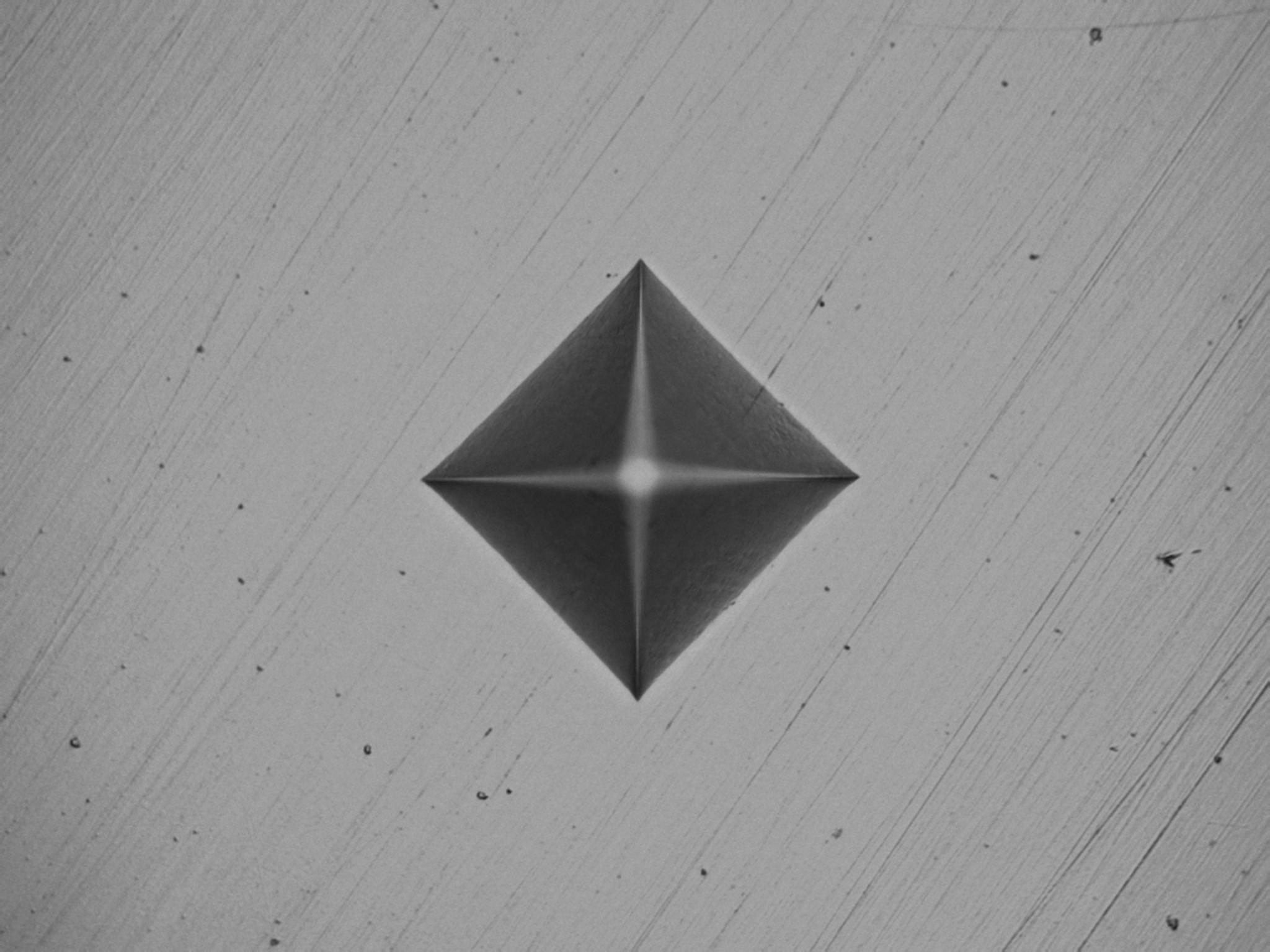 Vickers indentation: symmetrical, square-shaped, two diagonals measured.
 Knoop indentation: long and shallow, only the long diagonal measured.
Principle of the Vickers hardness test
The Vickers hardness test uses a square-based pyramidal diamond indenter with an angle of 136° between opposite faces. The indenter is pressed into the specimen surface under a specified test force; after the dwell time has elapsed and the force has been removed, the two diagonals of the residual indentation are measured optically and their arithmetic mean is used to calculate the hardness value. Because the indentation is symmetrical, Vickers testing is suitable for a wide range of applications, from microhardness on polished sections to macro Vickers on larger components. The reliability of the result depends strongly on the quality of the indentation image, the accuracy of the diagonal measurement, the flatness of the specimen, the perpendicularity between the test surface and the indenter axis, and the correct selection of test force for the material and thickness being tested.
Practical metrology note: always check both diagonals. If they differ significantly, or if one corner is not clearly defined, the indentation may be affected by surface preparation, specimen tilt, material anisotropy or incorrect focusing. In critical testing, repeat the indentation before accepting the result.
Vickers hardness formula
The Vickers hardness value is obtained by dividing the applied test force by the surface area of the indentation. Because the indenter has a fixed geometry, the value can be calculated from the test force and the average diagonal length:
HV = 1.8544 × F / d²
Here F is the test force in kilogram-force, d is the arithmetic mean of the two indentation diagonals in millimetres, and the constant 1.8544 comes from the geometry of the diamond pyramid. The diagonal is squared in the formula, so even a small optical measurement error, poor focus, surface deformation or an unclear corner can produce a significant hardness error, especially in low-force and microhardness testing.
 Vickers indenter geometry and indentation diagonals.
Calculator: Vickers hardness from the diagonal
Principle of the Knoop hardness test
The Knoop hardness test uses an elongated rhombic-based pyramidal diamond indenter. The resulting indentation is much longer than it is wide and shallower than a comparable Vickers indentation made under similar conditions. After the test force has been applied, held for the specified dwell time and removed, the long diagonal of the indentation is measured optically, and the Knoop hardness number is calculated from the applied force and the projected area related to that long diagonal. Because of its elongated, shallow geometry, the Knoop method is particularly useful for thin coatings, brittle materials, small components, case depth profiles close to edges, and applications where penetration depth must be minimized.
Practical metrology note: Knoop is useful for thin layers and coatings because the indentation is shallower than a comparable Vickers one. However, the long diagonal must be clearly visible from end to end. Poor contrast, edge effects or surface relief can make Knoop measurements unreliable.
Knoop hardness formula
The Knoop hardness value is calculated from the applied test force and the projected area of the elongated indentation. In practice, the long diagonal is measured and used to calculate the HK value:
HK = 14.229 × F / d²
Here F is the test force in kilogram-force and d is the length of the long diagonal in millimetres. The Knoop method is particularly sensitive to correct focus and diagonal measurement because the result depends directly on the measured length of the long diagonal. The elongated geometry reduces penetration depth compared with Vickers at comparable conditions, which is one of the reasons Knoop is widely used for thin coatings, brittle materials and applications requiring a shallow indentation.
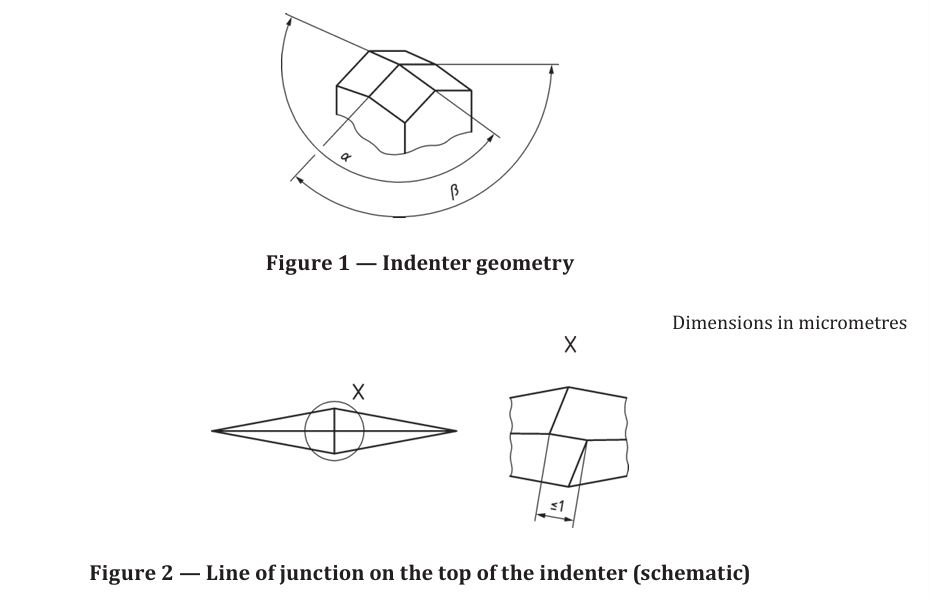 Knoop indenter geometry and the long diagonal used for HK.
Calculator: Knoop hardness from the long diagonal
Vickers and Knoop test forces and hardness scales
Vickers and Knoop hardness values must always be associated with the test force used during the measurement. The same material can give different practical results when tested with different forces, especially in microindentation testing, thin layers, coatings or materials with hardness gradients. The table below summarizes common Vickers and Knoop force designations; the availability of specific forces depends on the machine configuration, applicable standard, test method and laboratory procedure. The selection of the force depends on the material, expected hardness, layer thickness, indentation size and applicable standard.
| Vickers scale | Knoop scale | Test force N | Test force kgf | Test force gf |
|---|---|---|---|---|
| HV 0.001 | HK 0.001 | 0.009807 | 0.001 | 1 |
| HV 0.01 | HK 0.01 | 0.09807 | 0.01 | 10 |
| HV 0.015 | HK 0.015 | 0.1471 | 0.015 | 15 |
| HV 0.02 | HK 0.02 | 0.1961 | 0.02 | 20 |
| HV 0.025 | HK 0.025 | 0.2452 | 0.025 | 25 |
| HV 0.05 | HK 0.05 | 0.4903 | 0.05 | 50 |
| HV 0.1 | HK 0.1 | 0.9807 | 0.1 | 100 |
| HV 0.2 | HK 0.2 | 1.961 | 0.2 | 200 |
| HV 0.3 | HK 0.3 | 2.942 | 0.3 | 300 |
| HV 0.5 | HK 0.5 | 4.903 | 0.5 | 500 |
| HV 1 | HK 1 | 9.807 | 1 | 1000 |
| HV 2 | HK 2 | 19.61 | 2 | 2000 |
| HV 3 | — | 29.42 | 3 | 3000 |
| HV 5 | — | 49.03 | 5 | 5000 |
| HV 10 | — | 98.07 | 10 | 10000 |
| HV 20 | — | 196.1 | 20 | 20000 |
| HV 30 | — | 294.2 | 30 | 30000 |
| HV 50 | — | 490.3 | 50 | 50000 |
| HV 100 | — | 980.7 | 100 | 100000 |
| HV 120 | — | 1177 | 120 | 120000 |
Vickers covers the full range from microindentation to macro testing. Knoop is standardized up to HK 2 (2 kgf): it is an optical microindentation method designed for thin layers and brittle materials, so it is not used at the high macro forces available in Vickers.
Practical metrology note: do not select the test force only according to the expected hardness value. The force must also be compatible with specimen thickness, coating thickness, indentation size, surface finish and the distance from edges or adjacent indentations. Always verify the force range, scale designation and reporting format required by the applicable ASTM, ISO or internal procedure before issuing final results.
Sample preparation and surface requirements
Sample preparation is one of the most important factors in Vickers and Knoop testing. Since both methods require optical measurement of the indentation, the test surface must allow the indentation edges and corners to be clearly identified by the measuring system. The specimen should be flat, stable and properly supported, and the test surface should be perpendicular to the indenter axis so that the force is applied normally to the surface. If the specimen is tilted, poorly mounted or insufficiently supported, the indentation may appear distorted, the diagonals may be difficult to measure and the final value may be unreliable.
Surface preparation becomes more critical as the test force decreases. In micro Vickers and Knoop testing, very small indentations are measured, so scratches, polishing marks, oxide layers, etching, contamination or surface relief can strongly influence the result. For this reason, polished metallographic preparation is often required when testing thin layers, case depth profiles, weld zones or microstructural constituents. ATI also supplies machines for metallographic sample preparation to support consistent surface quality.
Practical metrology note: etching should normally be avoided before making the indentation, unless the procedure specifically requires it. Etched surfaces can make the indentation boundary less clear and increase the uncertainty of diagonal measurement.
Specimen support and mounting
To obtain reliable results the test surface should be perpendicular to the indenter axis. Non-parallel or irregular specimens may require clamping, leveling fixtures or special supports to align the surface correctly. In microindentation testing, specimens are often mounted to simplify preparation, protect edges and allow hardness traverses across surface layers, welds or heat-treated zones. When mounting is required, the specimen must be adequately supported by the mounting medium; excessively soft or creeping mounting compounds should be avoided, because specimen movement during force application can alter the indentation geometry and reduce reliability.
Optical measurement of the indentation
In Vickers testing both diagonals are measured and the average length is used; in Knoop testing the long diagonal is measured. The indentation should remain within the usable optical field of the selected objective, and the magnification should suit the indentation size. Correct focus and image quality are essential: the corners must be clearly visible, sharply defined and free from surface defects. Because both formulas depend on the square of the measured diagonal, small measurement errors produce significant hardness errors, so the smaller the indentation, the higher the required measurement accuracy. Distorted indentations can indicate alignment or support problems — in Vickers, if one half of a diagonal is significantly longer than the other or the four corners are not in sharp focus; in Knoop, if the two halves of the long diagonal differ significantly or both ends are not sharply focused.
Practical metrology note: since the diagonal is squared in the formula, a small measurement error produces a large hardness error. This is especially critical in microhardness testing, where indentations are very small.
Testing temperature
Vickers and Knoop tests are generally performed under controlled laboratory conditions, commonly between 10 °C and 35 °C, or within the range specified by the applicable standard or internal procedure. For high-accuracy work, reference testing, calibration activities or inter-laboratory comparison, it may be advisable to control the temperature within a narrower range, since stable environmental conditions reduce measurement variability and improve consistency.
Minimum spacing for Vickers and Knoop indentations
Usually more than one indentation is made on a specimen, so the spacing between indentations must be large enough that adjacent tests do not interfere with each other. For most purposes, the minimum spacing between separate indentations, and the minimum distance between an indentation and the edge of the specimen, should be based on the indentation diagonal length. A commonly used practical rule is to keep a distance of at least 2.5 times the indentation diagonal, unless the applicable standard or internal procedure requires a different value. Spacing is especially important in microindentation testing, case depth profiles and coating evaluation, where plastic deformation from one indentation can influence the next if the points are too close.
 Minimum spacing between indentations and from the specimen edge.
Practical metrology note: when making hardness traverses for case depth or coating evaluation, spacing must be planned before testing. If the first indentation is too close to the surface, the edge or a previous indentation, the entire profile may become difficult to validate.
Vickers and Knoop repeatability, error and verification
Reliable Vickers and Knoop testing requires control of both the force application system and the optical measuring system. Since the value is calculated from the measured diagonal, errors in image quality, focus, diagonal reading, surface preparation or operator interpretation directly affect the result. The two calculators below return the maximum allowable repeatability and error for a chosen scale and hardness, showing ISO and ASTM limits side by side.
Machine error E
The machine error E is the difference between the hardness value measured by the machine and the certified reference value of a standardized hardness test block, evaluated at specific hardness levels and forces during indirect verification. In practical terms, E indicates whether the tester reads too high or too low compared with the reference. If the error exceeds the permitted tolerance, the machine, measuring system, indenter, force application or calibration condition must be investigated before the results can be considered reliable.
Repeatability R
Repeatability R describes how consistently the machine reproduces results under the same verification conditions, typically evaluated from the spread of a series of indentations on a certified test block. Good repeatability means the machine, indenter, optical system and setup are producing stable results. Poor repeatability may indicate unstable force application, specimen movement, poor surface preparation, optical focusing errors, operator influence, dirty optics, damaged indenters or incorrect indentation measurement.
Verification using certified test blocks
Vickers and Knoop machines should be verified periodically using certified hardness reference blocks suitable for the forces and hardness ranges normally used. Blocks should be clean, properly supported and used according to the applicable standard. The selected block should be close to the expected hardness range and force level of the measurements normally performed; an unsuitable force, range or damaged block reduces the value of the verification. In routine practice, verification uses certified Vickers and Knoop hardness test blocks with known reference values, checking the complete system: force application, indenter condition, optical measurement and software calculation. For formal compliance, audits, maintenance programs or inter-laboratory comparison, ATI provides ISO/IEC 17025 accredited calibration services.
Practical metrology note: use certified test blocks close to the force level and hardness range normally used. Verifying the machine only at a very different hardness level or force may not provide enough confidence for critical microhardness measurements.
Maximum allowable repeatability and error
The tables below summarize the maximum allowable repeatability and error limits for Vickers and Knoop testing machines, according to the reference standards used for verification and calibration.
ASTM E92-23, Table A1.4 — maximum allowable repeatability and error
| HV range | Force (gf) | Max repeatability R (% HV) | Max error E (% HV) |
|---|---|---|---|
| ≥ 100 to < 240 | > 1000 | 4 | ± 2 |
| > 240 to ≤ 600 | > 1000 | 3 | ± 2 |
| > 600 | > 1000 | 2 | ± 2 |
| > 0 | 1 ≤ F < 100 | 13 | ± 3 |
| < 100 | 100 ≤ F ≤ 1000 | 13 | ± 3 |
| 100 ≤ HV ≤ 240 | 100 ≤ F < 500 | 13 | ± 2 |
| 240 < HV ≤ 600 | 100 ≤ F < 500 | 5 | ± 2 |
| HV > 600 | 100 ≤ F < 500 | 4 | ± 2 |
| 100 ≤ HV ≤ 240 | 500 ≤ F < 1000 | 8 | ± 2 |
| 240 < HV ≤ 600 | 500 ≤ F < 1000 | 4 | ± 2 |
| HV > 600 | 500 ≤ F < 1000 | 3 | ± 2 |
Note 1: in all cases the repeatability is satisfactory if (d max − d min) is 1 µm or less. Note 2: the error is satisfactory if E = 100 × |d avg − d ref| / d ref is 0.5 µm or less.
Practical metrology note: for ASTM E92-23 the force range is decisive when judging the permitted repeatability and error. Always check both the hardness range and the applied force before assessing machine performance.
ISO 6507-2:2018, Table 4 — maximum repeatability of the Vickers machine
| Hardness of reference block | Relative repeatability rrel, % | Repeatability r, HV — HV 5 to HV 100 | Repeatability r, HV — HV 0.2 to < HV 5 | ||||
|---|---|---|---|---|---|---|---|
| HV 5 to HV 100 | HV 0.2 to < HV 5 | < HV 0.2 | Block HV | HV | Block HV | HV | |
| ≤ 225 HV | 3.0 a | 6.0 a | 9.0 a | 100 200 |
6 12 |
100 200 |
12 24 |
| > 225 HV | 2.0 a | 4.0 a | 5.0 a | 250 350 600 750 |
10 14 24 30 |
250 350 600 750 |
20 28 48 60 |
a Or 0.001 mm, whichever is greater.
Practical metrology note: ISO 6507-2 evaluates repeatability either as a relative percentage or as an absolute hardness difference, depending on the hardness level and force range. This matters when comparing macro Vickers and low-force Vickers verification results.
ISO 6507-2:2018, Table 4 — maximum permissible percentage error Erel
| Hardness symbol | 50 | 100 | 150 | 200 | 250 | 300 | 350 | 400 | 450 | 500 | 600 | 700 | 800 | 900 | 1000 | 1500 |
|---|---|---|---|---|---|---|---|---|---|---|---|---|---|---|---|---|
| HV 0.01 | ||||||||||||||||
| HV 0.015 | 10 | |||||||||||||||
| HV 0.02 | 8 | |||||||||||||||
| HV 0.025 | 8 | 10 | ||||||||||||||
| HV 0.05 | 6 | 8 | 9 | 10 | ||||||||||||
| HV 0.1 | 5 | 6 | 7 | 8 | 8 | 9 | 10 | 10 | 11 | |||||||
| HV 0.2 | 4 | 6 | 8 | 9 | 10 | 11 | 11 | 12 | 12 | |||||||
| HV 0.3 | 4 | 5 | 6 | 7 | 8 | 9 | 10 | 10 | 11 | 11 | ||||||
| HV 0.5 | 3 | 5 | 5 | 6 | 6 | 7 | 7 | 8 | 8 | 9 | 11 | |||||
| HV 1 | 3 | 4 | 4 | 4 | 5 | 5 | 5 | 6 | 6 | 6 | 8 | |||||
| HV 2 | 3 | 3 | 3 | 4 | 4 | 4 | 4 | 4 | 5 | 5 | 6 | |||||
| HV 3 | 3 | 3 | 3 | 3 | 3 | 4 | 4 | 4 | 4 | 4 | 5 | |||||
| HV 5 | 3 | 3 | 3 | 3 | 3 | 3 | 3 | 3 | 3 | 4 | 4 | |||||
| HV 10 | 3 | 3 | 3 | 3 | 3 | 3 | 3 | 3 | 3 | 3 | 3 | |||||
| HV 20 | 3 | 3 | 3 | 3 | 3 | 3 | 3 | 3 | 3 | 3 | 3 | |||||
| HV 30 | 3 | 3 | 2 | 2 | 2 | 2 | 2 | 2 | 2 | 2 | 2 | |||||
| HV 50 | 3 | 3 | 2 | 2 | 2 | 2 | 2 | 2 | 2 | 2 | 2 | |||||
| HV 100 | 3 | 2 | 2 | 2 | 2 | 2 | 2 | 2 | 2 | 2 |
Note 1: values are not given when the indentation diagonal is less than 0.020 mm. Note 2: for intermediate values, the maximum permissible error may be obtained by interpolation. Note 3: the values for microhardness machines are based on a maximum permissible error of 0.001 mm or 2 % of the mean diagonal length, whichever is greater.
Practical metrology note: blank cells do not mean the machine has no limit. They indicate that no value is given for that combination of hardness symbol and reference hardness, typically because the indentation diagonal would be too small for reliable optical measurement.
Microhardness, case depth, coatings and practical applications
Vickers and Knoop tests are widely used when a localized hardness measurement is required. Unlike methods based on penetration depth, these optical indentation methods let the operator select precise test locations under magnification and measure small areas, layers or microstructural zones.
Microhardness testing
Micro Vickers and Knoop measure very small indentations produced by low forces, suitable for thin specimens, small parts, polished cross-sections, microstructural constituents and research where the test area is limited.
Case depth and profiles
Vickers is commonly used for hardness profiles across hardened layers, carburized cases, nitrided layers, induction-hardened zones and weld heat-affected zones, with indentations made at controlled distances from a reference line. See case depth measurement (CHD).
Coatings and thin layers
Knoop is often preferred for coatings and thin layers because the indentation is long and shallow, reducing excessive penetration into the substrate when the available layer thickness is limited.
Brittle materials and ceramics
Knoop is frequently used for brittle materials, ceramics and hard coatings, since the elongated indentation can reduce cracking tendency compared with deeper geometries. Vickers may also be used depending on material and force.
Welds and heat treatment
Both tests are performed on polished cross-sections and linked to visible microstructure, allowing hardness evaluation in weld zones, base material, heat-affected zones and surface-treated layers.
Metallographic analysis
Because the test position is chosen under magnification, individual microstructural regions and constituents can be evaluated, making the methods valuable tools in metallographic laboratories.
Vickers and Knoop terminology and practical tips
Correct Vickers and Knoop testing depends not only on the test force and indenter, but also on the condition of the machine, the optical measuring system, the specimen support, the surface preparation and the verification procedure. The following terminology and notes summarize the main elements that influence the reliability of HV and HK results.
Calibration
Calibration is the determination of significant parameters by comparison with a reference instrument, certified reference material or recognized standard. In Vickers and Knoop testing it may involve verification of test force application, indentation measuring system performance, indenter geometry and overall machine performance using certified reference blocks. For laboratories working under quality systems, customer audits or accreditation, calibration provides documented evidence that the tester performs within the required limits and that results are traceable. ATI offers ISO/IEC 17025 accredited calibration services and certified hardness test blocks for routine verification and metrological control.
Verification and standardization
Verification is the checking of the testing machine to confirm conformity to the applicable specification, normally performed with certified Vickers or Knoop test blocks of known reference values. Standardization is the process of bringing the instrument into conformity with a known standard through calibration, adjustment or verification. Regular verification is essential because small variations in force application, optical measurement, indenter condition or alignment can significantly affect the final value, especially in low-force and microindentation testing.
Vickers and Knoop indenters
The Vickers indenter is a highly polished, square-based pyramidal diamond with 136° between opposite faces, producing a symmetrical indentation whose two diagonals are averaged to calculate HV. The Knoop indenter is a highly polished, elongated rhombic-based pyramidal diamond producing a long, shallow indentation, where HK is calculated from the long diagonal. Indenters should be inspected periodically and replaced if worn, chipped, cracked, dulled or separated from their mounting; a damaged indenter can produce distorted indentations, unclear corners or systematic errors.
The testing machine and optical system
A Vickers or Knoop machine must support the specimen securely and apply the selected force in a controlled, repeatable manner along an axis perpendicular to the test surface, then allow accurate optical measurement of the indentation after unloading. Because these are optical methods, the measuring system is as important as the force system: the machine should provide suitable magnification, stable illumination, proper focusing and sufficient optical resolution for the indentation size. Automatic image analysis can reduce operator influence and improve repeatability, especially for small microhardness indentations.
Specimen support and anvils
The specimen must be supported rigidly during force application; any movement, bending, vibration or lack of support can alter the indentation shape. The support surface, fixture or anvil should be clean, smooth and free from pits, deep scratches or contamination. Flat specimens should be tested on a flat support whose bearing plane is perpendicular to the indenter axis, while cylindrical, small or irregular parts may require V-groove anvils, parallel supports or clamping fixtures. In microindentation testing, mounted specimens must be adequately supported by the mounting material, avoiding soft or creeping compounds that allow movement under load.
Common sources of error
Most errors in Vickers and Knoop testing are caused not by the tester alone but by the interaction between sample preparation, force application, optical measurement and operator procedure. Since the value is calculated from the indentation size, every factor that distorts the indentation affects the result.
- Unclear indentation corners — poor polishing, contamination, etching or low contrast make the tips hard to identify.
- Incorrect focus — if the corners are not in sharp focus, the surface may not be perpendicular or the optics may be misadjusted.
- Insufficient spacing — indentations too close together or to an edge are affected by prior deformation or lack of support.
- Unstable specimen support — movement, bending or creeping mounting media alter the geometry during loading.
- Damaged or contaminated indenter — produces distorted indentations and systematic errors.
- Wrong force selection — too high for a thin layer or too low for a rough surface gives unreliable results.
- Operator influence — manual diagonal reading depends on focus, contrast and interpretation; automatic image analysis helps but still needs correct setup.
Practical metrology note: if a result looks unexpected, do not immediately assume the material is wrong. First check surface preparation, focus, indentation shape, support stability, selected force, spacing and the condition of the indenter. Most practical errors in optical indentation testing are related to setup and measurement conditions.
Explore Vickers, Knoop and microhardness testers built for laboratory and quality control.

Frequently asked questions
What is the difference between the Vickers and Knoop hardness tests?
Both press a diamond indenter into the surface and measure the indentation optically, but Vickers uses a symmetrical square-based pyramid and measures the average of two diagonals (HV), while Knoop uses an elongated pyramid and measures only the long diagonal (HK). Knoop produces a longer, shallower indentation, which suits thin layers, coatings and brittle materials.
What do the Vickers and Knoop formulas mean?
Vickers is HV = 1.8544 × F / d² and Knoop is HK = 14.229 × F / d², where F is the test force in kgf and d is the diagonal in millimetres (the mean of the two diagonals for Vickers, the long diagonal for Knoop). Because the diagonal is squared, a small measurement error produces a large hardness error.
How should a Vickers or Knoop result be reported?
Always with the symbol and the test force, for example 700 HV 0.1 or 500 HK 0.5. The number after the symbol is the force in kilogram-force. A value reported as a number alone is incomplete for technical reports, audits and comparisons.
How do I choose the test force?
The force must suit the material, expected hardness, layer or specimen thickness, indentation size, surface finish and distance from edges and adjacent indentations. Lower forces suit thin layers, coatings, case depth profiles and small areas; higher forces suit larger, homogeneous, well-supported samples. The indentation must be large enough to read clearly but not so large that it reaches edges or the substrate.
What is the maximum Knoop test force?
Knoop is standardized up to HK 2 (2 kgf). It is an optical microindentation method designed for thin layers and brittle materials, so it is not used at the high macro forces available in Vickers, which extends up to HV 100 and beyond.
What is the minimum spacing between indentations?
A common practical rule is at least 2.5 times the indentation diagonal between separate indentations and from the specimen edge, unless the applicable standard or procedure requires a different value. Spacing must be planned before testing, especially for case depth profiles.
Why is sample preparation so important for Vickers and Knoop?
Because the value is calculated from the optically measured diagonal. Scratches, oxide layers, contamination, etching or surface relief can hide the indentation corners and increase measurement uncertainty. The smaller the force and indentation, the more critical the preparation, which is why polished metallographic surfaces are often required for microhardness, coatings and case depth work.
Which standards define Vickers and Knoop hardness testing?
Vickers is defined by ISO 6507 and ASTM E92; Knoop by ISO 4545 and ASTM E92; and microindentation testing of both by ASTM E384. The applicable standard depends on the force range, application and type of test.
How are repeatability and error verified?
Through indirect verification with certified hardness test blocks close to the force and hardness range used. Repeatability R is the spread of repeated indentations; error E is the difference from the certified reference value. ISO 6507-2, ISO 4545-2 and ASTM E92/E384 define the maximum allowable limits, shown in the tables and calculators above.
Author and technical responsibility
Technical content reviewed by the ATI (Affri Testing Instruments) Metrology Engineering Team, with expertise in hardness testing methods, international standards, accredited calibration and industrial quality control.
Need help with a Vickers or Knoop application?
Our metrology engineers can help you choose the Vickers or microhardness tester, the force range, the optical system, the test blocks and the calibration program for your application. For broader method selection, see the Hardness Testing Academy or the general hardness testing overview.
Talk to our hardness testing experts.