
Vickers Hardness Testing
A practical guide to choosing the test force, preparing the sample, reading the indentation and avoiding common measurement errors.
Vickers hardness testing is one of the most useful methods when you need to measure a specific point, a small area, a thin layer, a heat treated surface or a polished metallographic section. Unlike Rockwell, which gives a direct value from penetration depth, Vickers requires an optical measurement of the indentation diagonals, which makes it very flexible but also more sensitive to sample preparation, focus, surface finish and operator procedure. This guide focuses on real testing conditions: force selection, sample preparation, indentation reading, case depth profiles and the mistakes to avoid.
- What is Vickers hardness testing?
- When should you use the Vickers test?
- How the Vickers test works in practice
- How to choose the test force
- How to prepare the sample
- How to read a Vickers indentation
- Is the result valid?
- Case depth and hardness profiles
- Standards
- Vickers vs Rockwell vs Brinell
- From method to equipment
- Calibration and test blocks
- Frequently asked questions
- Author and technical responsibility
- Contact our technical team
What is Vickers hardness testing?
Vickers hardness testing is an optical indentation method that measures hardness by pressing a diamond pyramid indenter into the surface under a defined force. After the force is removed, the two diagonals of the square indentation are measured, and the hardness is calculated from the force and the average diagonal length: a smaller indentation means a harder material, a larger one a softer material. The result is expressed as HV followed by the test force, so 700 HV 0.5 means a Vickers hardness of 700 measured with a 0.5 kgf force.
Practical metrology note: never report a Vickers value as a number alone. Always include the test force. A value written as 700 HV 0.5 is complete; a value written only as 700 HV is incomplete for technical reports, audits and comparisons.
When should you use the Vickers test?
Vickers is the right choice when Rockwell or Brinell is too large or too fast for the level of detail needed, especially when the test point must be chosen under a microscope or the material has local hardness variations. Use it to measure hardness on a polished cross section, to check a heat treated layer, to map a profile from surface to core, to test small areas, to compare the zones of a weld, to measure thin or surface treated materials, and for microhardness in the laboratory. Avoid Vickers as the first choice when the surface is rough, when the test must be extremely fast, or when the part can be tested more easily with Rockwell or Brinell.
How the Vickers test works in practice
The practical Vickers sequence is straightforward:
- Prepare the surface. The test area must be clean, flat and suitable for optical measurement.
- Select the test force. Match the force to the material, thickness, expected hardness and purpose of the test.
- Focus and choose the point. The operator selects the test position under the optical system.
- Apply the indentation. The diamond indenter is pressed into the material under the selected force.
- Measure the diagonals. After unloading, both diagonals of the indentation are measured.
- Check the indentation. It must be clear, regular and far enough from edges and other indentations.
The key practical difference from Rockwell is that the operator, camera or software must correctly identify the indentation corners; if the indentation cannot be measured clearly, the result should not be trusted. For the principle and formula, see the Vickers and Knoop theory.
How to choose the right Vickers test force
Choosing the test force is one of the most important practical decisions. Too high a force can give an indentation that is too large, too deep or too close to the substrate in thin layers; too low a force can give one too small to measure reliably, especially on an imperfect surface. As a rule, use lower forces for thin layers, coatings, case depth profiles and very small areas, and higher forces for larger, homogeneous, well supported samples, always making sure the indentation is large enough to read clearly but not too large for the available area or spacing.
| Application | Practical force selection advice |
|---|---|
| Polished microstructure | Use low microhardness forces and verify that the indentation corners are clearly visible. |
| Case depth profile | Select a force that allows multiple indentations at controlled distances without overlap. |
| Thin coating | Use a low force and verify that the indentation is not influenced by the substrate. |
| Weld section | Use a force suitable for the width of the weld zones and heat affected areas. |
| General laboratory testing | Use the force required by the standard, specification or customer procedure. |
Practical metrology note: do not choose the force only because it is commonly used. The correct force depends on material thickness, expected hardness, indentation size, distance from edges and the purpose of the measurement.
How to prepare the sample correctly
Vickers is highly dependent on surface preparation, because the value is calculated from the measured diagonals and the surface must let the operator or software identify all four corners clearly. The surface should be flat, clean, stable, free of oxide scale and heavy scratches, perpendicular to the indenter axis and suitable for optical measurement. For macro Vickers a properly ground or machined surface may be acceptable, but for micro Vickers, case depth profiles and coatings a polished metallographic surface is normally required. A rough or poorly polished surface can create more error than the tester itself. For full metallographic workflows, ATI also supplies machines for metallographic sample preparation.
Practical metrology note: if the indentation is not clear, do not guess the diagonal. Improve the surface preparation, adjust focus and illumination, or repeat the test on a better prepared area.
How to read a Vickers indentation
A good Vickers indentation looks regular, symmetrical and clearly defined, with both diagonals visible from corner to corner. Before accepting the result, check that all four corners are sharp and visible, that the two diagonals are reasonably consistent, that the indentation is not too close to an edge or to another indentation, that no scratches cross the corners, that the image is focused and that the surface is not tilted. If the indentation appears stretched, distorted, out of focus or unclear, the result should be reviewed.
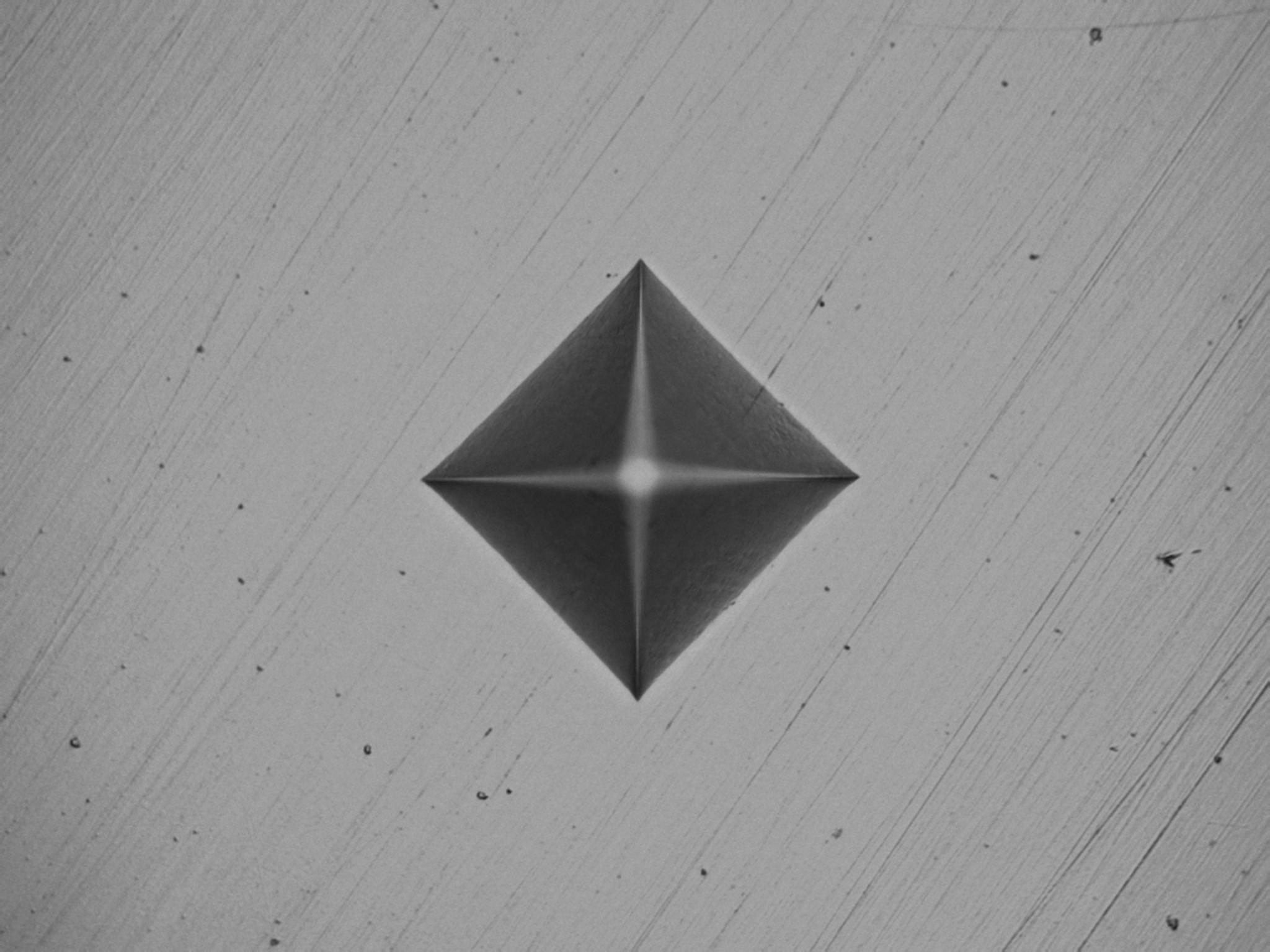
Practical metrology note: a Vickers indentation can be measured correctly only if the corners are optically clear. If the operator cannot identify the corners with confidence, the result is weak even when the machine is perfectly calibrated.
Calculator: Vickers hardness from the diagonal
Calculator: Knoop hardness from the long diagonal
How to know if the result is valid
A Vickers result should be accepted only when the test conditions and indentation quality are acceptable. Treat it as questionable or invalid if the indentation is too close to the edge or to another indentation, if the surface is not flat or not perpendicular to the indenter, if the specimen moved during the test, if the corners are unclear, if the force is not suitable for the material thickness, if the preparation is too rough for the selected force, or if the two diagonals differ significantly because of distortion or tilt. When a value looks unexpected, repeat the test after checking preparation, focus, support and force, rather than assuming the material is wrong.
Vickers testing for case depth and hardness profiles
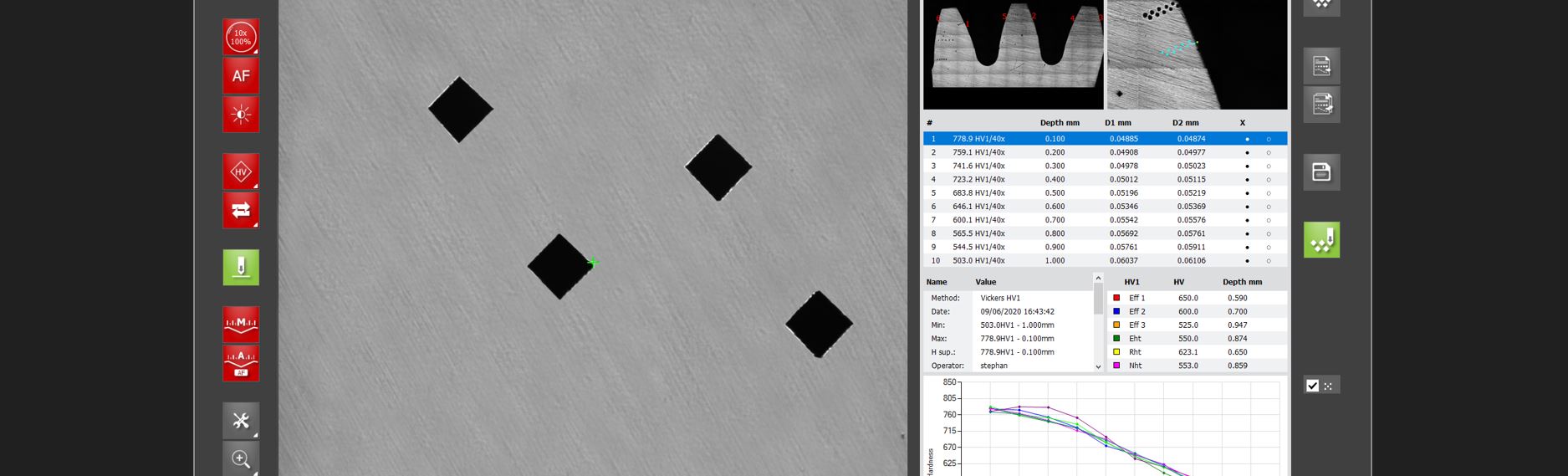
Vickers is widely used for case hardness depth (CHD) and hardness profile measurement, because it lets a sequence of small indentations be made at controlled distances from the surface. This is common for carburized, nitrided and induction hardened layers, weld heat affected zones, surface treated steels and thin hardened layers. In practice the operator prepares a polished cross section and runs a line of indentations from the surface toward the core, then plots hardness against distance. The key points are a polished, well supported surface, a first indentation not too close to the edge, sufficient spacing between indentations, a force that gives a readable but not excessive indentation, and a test pattern planned before starting. Modern automatic Vickers testers simplify this with motorized stages, predefined patterns, automatic reading and CHD reporting, as described in the case depth measurement guide.
Practical metrology note: for case depth profiles, the force and the indentation spacing must be chosen together. If the force is too high, the indentations become too large and the profile may not fit correctly within the hardened layer.
Standards for Vickers hardness testing
Vickers hardness testing is governed by international standards that define the method, force application, indentation measurement, spacing, reporting and verification: chiefly ISO 6507 (Metallic materials, Vickers hardness test), ASTM E92 (Vickers and Knoop hardness of metallic materials) and ASTM E384 (microindentation hardness of materials). Following the correct standard is essential for traceability, repeatability and comparability. For the full theory, see the Vickers and Knoop hardness test theory.
Vickers vs Rockwell vs Brinell
Vickers is not always the fastest method, but it is often the most useful when the test area is small or the hardness distribution must be evaluated locally.
| Method | Best practical use | Main advantage |
|---|---|---|
| Rockwell | Fast routine testing on suitable metal parts | Direct reading, fast cycle, minimal optical measurement |
| Brinell | Castings, forgings and inhomogeneous materials | Large indentation, good average over coarse structures |
| Vickers | Small areas, thin layers, case depth, welds and laboratory testing | Precise optical measurement and a wide force range |
In short, choose Rockwell when speed and direct reading are the priority, Brinell when the material is coarse, cast or inhomogeneous, and Vickers when the test location, profile or small indentation is important. See the full Rockwell vs Brinell vs Vickers comparison.
From method to equipment
Once the method and force are defined, the right tester matters. ATI (Affri Testing Instruments) builds Vickers hardness testers for microhardness, low force and macro Vickers, Knoop hardness, case depth profiles, weld testing, coating and surface layer evaluation and general laboratory and quality control. Depending on configuration they offer manual or automatic indentation reading, motorized stages, automatic focus, predefined patterns, CHD software and report generation.
Find the Vickers or microhardness tester that fits your work.
Why calibration and test blocks matter
Reliable Vickers testing needs not only a good instrument but proper verification and calibration, because the result depends on force application, indenter condition and optical measurement. A good control process includes periodic verification with certified Vickers test blocks, inspection of the indenter, checking of the optical measuring system, proper machine calibration and documented traceability for audits. ATI supplies certified hardness test blocks and provides ISO/IEC 17025 accredited calibration for hardness testers and measuring systems.

Practical metrology note: for routine verification, use test blocks close to the hardness range and force level you normally use. A check at a very different force or hardness may not represent your real testing conditions.
Frequently asked questions
In simple terms, what does Vickers hardness measure?
It measures how resistant a material is to indentation. A diamond pyramid is pressed into the surface, and the size of the indentation is measured optically; a smaller indentation means a harder material.
When should I choose Vickers instead of Rockwell?
Choose Vickers when the test area is small, when you need a polished cross section, when you need a hardness profile, or when the exact test position matters. Rockwell is usually faster for routine production testing on suitable parts.
Why is sample preparation so important in Vickers testing?
Because the value depends on the optical measurement of the diagonals. If the surface is rough, scratched or poorly polished, the indentation corners may not be clear and the result may be unreliable.
How do I choose the correct Vickers test force?
The force depends on material thickness, expected hardness, surface condition, layer thickness and the purpose of the test. The indentation must be large enough to measure clearly, but not so large that it reaches edges, nearby indentations or the substrate.
Can Vickers be used for case depth measurement?
Yes. Vickers is one of the most common methods for case hardness depth profiles. A sequence of indentations is made from the surface toward the core, and the hardness values evaluate the gradient.
What makes a Vickers result invalid?
It may be invalid if the indentation is too close to an edge or another indentation, poorly focused, distorted, unclear, made on a rough surface, or produced with an unsuitable test force.
Which standards define Vickers hardness testing?
The main reference standards are ISO 6507, ASTM E92 and ASTM E384, depending on the force range, application and type of test.
Author and technical responsibility
Technical content reviewed by the ATI (Affri Testing Instruments) Metrology Engineering Team, with expertise in hardness testing methods, international standards, accredited calibration and industrial quality control.
Not sure which Vickers setup fits your application?
Our metrology engineers can help you choose the Vickers or microhardness tester, the force range, the optical system, the test blocks and the calibration program for your application.
Talk to our hardness testing experts.