Hardness Testing
Methods, applications, standards and how to choose the right hardness tester.
Hardness testing is a fundamental quality control method that measures how strongly a material resists permanent, localized deformation when an indenter is pressed into its surface. In metals and alloys the hardness value correlates closely with properties such as tensile strength, wear resistance and heat treatment condition, which is why hardness testing runs through almost every stage of manufacturing, from incoming inspection and process control to failure analysis and research and development. This guide gives a clear, practical overview of hardness testing: what it really measures, the main methods (Rockwell, Brinell, Vickers, universal and portable), the standards that govern it, and how to choose the most suitable hardness tester for your parts. For the full learning path see the Hardness Testing Academy, and for the mechanics behind the numbers see the physics of hardness.
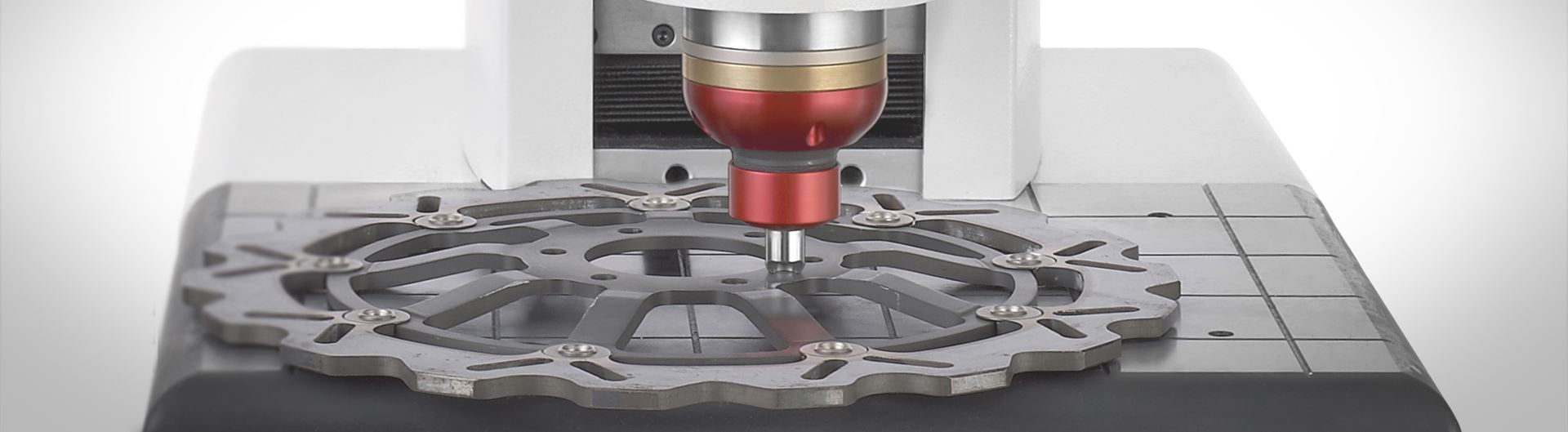
- What is hardness testing?
- Why it matters in industry
- Standards and traceability
- General test conditions
- Main hardness test methods
- Typical applications
- How to choose the right tester
- From method to equipment
- Certified hardness test blocks
- Why a certified solution
- Frequently asked questions
- Author and technical responsibility
What is hardness testing?
Hardness is not a single fundamental property of a material, like density or melting point, but a measured response: the resistance a surface offers to permanent deformation under a defined load. A hardness test presses an indenter of known geometry, a diamond cone, a hardened ball or a diamond pyramid, into the surface under a controlled force, and derives a number from how the material yields. Higher numbers mean a harder material that deforms less under the same conditions.
Although a material can resist indentation, scratching and abrasion, industrial testing on metals almost always measures indentation hardness, because it is fast, repeatable and closely tied to strength and wear. The value is read in one of two ways: from the depth the indenter reaches, which is how the Rockwell method works, or from the size of the impression it leaves, which is how Brinell and Vickers work. This distinction between depth and area is the reason different methods can give slightly different results on the same part, and it is explained in detail in the physics of hardness.
Why hardness testing matters in industry
Hardness testing is so widely adopted because it delivers fast, repeatable insight into both the condition of a material and the stability of the process that produced it, usually in seconds and with minimal damage to the part. A single reading can confirm that a heat treatment landed in spec, that a batch of incoming steel matches its certificate, or that a machining step has not left the surface work hardened or soft, which makes it one of the most cost effective checks in the laboratory and on the shop floor.
Heat treatment
Verify that quenching, tempering and case hardening reached the target hardness.
Incoming material
Confirm that supplied metal matches its certificate before it enters production.
Process control
Monitor machining and forming for drift, batch after batch.
Failure analysis
Support root cause investigations and estimate strength and wear from hardness.
Standards and traceability
Hardness testing is governed by international standards that fix the indenter, the force, the dwell time, the procedure and the rules for verifying the machine, so that a value measured in one laboratory means the same thing in another. The core references are the ISO 6506, 6507 and 6508 series and the ASTM E10, E18, E92 and E384 methods for Brinell, Vickers and Rockwell, together with ISO 18265 and ASTM E140 for converting between scales. Working to them is what delivers repeatability and reproducibility, traceability to certified reference blocks, and comparability of results across sites and suppliers.
That traceability rests on accredited calibration. An ISO/IEC 17025 accredited calibration and a set of certified reference blocks keep a tester honest, while a hardness conversion table lets you relate values between scales when a specification requires it.
General test conditions
A valid result depends not only on the method but on the conditions of the test, and most disputed readings trace back to a few avoidable factors. Keep the surface clean and stable, free of scale, heavy roughness or coatings unless the coating itself is being tested; make sure the specimen is thick enough that the anvil does not influence the result, using the field check of turning the part over to look for a mark on the back; and support the part firmly so it cannot rock under load. Equally important, keep enough distance between indentations and from the edges so the plastic zones do not overlap, and isolate the tester from vibration, which matters most at low loads and in microhardness work.
Main hardness test methods
Several methods exist because parts vary so widely in material, thickness, microstructure and production volume, and no single test is ideal for all of them. The cards below summarize the main industrial methods at a glance, the table that follows compares them side by side, and the sections after that describe each one with its dedicated guide. For a side by side comparison of the three main methods, see Rockwell vs Brinell vs Vickers.
Brinell
Measures the diameter of a large impression, ideal for coarse or inhomogeneous materials.
Custom and integrated
Special, application specific testers and automated cells built into production lines.
| Method | Measurement principle | Best for | Typical use |
|---|---|---|---|
| Rockwell | Depth of penetration | Fast quality control on metals | Production testing, heat treated parts |
| Brinell | Indentation diameter | Coarse grained, inhomogeneous materials | Castings, forgings, large sections |
| Vickers | Diagonal length (optical) | Wide range and thin sections | Laboratory testing, welds, microhardness |
| Universal | All methods in one machine | Flexible, multi method work | R&D, advanced QC, incoming material |
| Portable | Dynamic, ultrasonic or impact | Large parts, field testing | On site checks, installed assemblies |
| Custom and integrated | Tailored setup, often automated | Special parts and high volume lines | Bespoke cells, in line testing |
Rockwell hardness testing (depth based)
Rockwell is one of the most widely used methods in production because it gives a direct reading with no optical measurement: the machine applies a preliminary force, then a total force, then returns to the preliminary force, and converts the permanent increase in depth straight into a hardness number. That makes it fast, easy to automate and well suited to high throughput quality control on hardened steels and alloys, where high repeatability and standardized scales matter most. Diamond cone indenters are used for hard materials and ball indenters for softer ones, which is why Rockwell has several scales such as HRC and HRB.

Brinell hardness testing (macro indentation)
Brinell presses a tungsten carbide ball into the surface under a heavy load and derives the hardness from the diameter of the round impression, measured optically. Because the indentation is large, it averages over a wide area and many grains, which makes Brinell the preferred method for coarse grained or inhomogeneous materials where a small indenter would land on a single phase and mislead. The trade off is that it needs adequate surface preparation and a part thick enough to carry the large impression.

Vickers hardness testing (optical and microhardness)
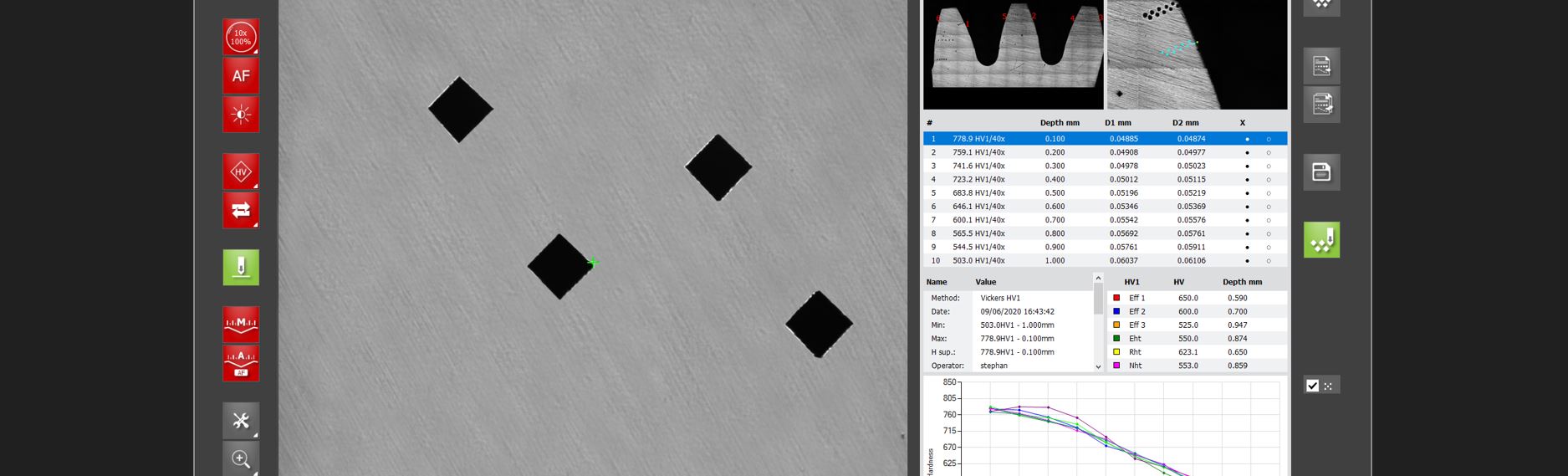
Vickers uses a diamond pyramid indenter and calculates hardness from the two diagonals of the square impression. Because the pyramid is geometrically self similar, the hardness number is essentially independent of the load, so a single method covers everything from microhardness on a thin coating to macro testing on a bulk part simply by changing the force. That broad range, together with high resolution, makes Vickers the reference method for metallurgical work such as weld surveys and case depth measurement. Since the reading is optical, stable lighting, correct focus and a consistent surface finish are essential.
Universal hardness testing (multi method machines)
Universal hardness testers combine several methods in a single instrument, so one machine can run Rockwell, Brinell and Vickers tests across many scales without changing equipment. They suit laboratories and quality departments that handle a wide variety of materials and standards, especially in incoming inspection, where multi tool turrets, automatic load selection and an integrated measuring system standardize procedures across products and batches. Mechanically they range from low load systems up to around 250 kgf for general laboratory use to heavy load systems up to 3000 kgf for large parts and high force Brinell testing. Learn more in the universal hardness testing guide.
Portable hardness testing (on site and large parts)
Portable hardness testers are built for the cases where the part cannot come to the laboratory, using dynamic rebound, ultrasonic contact impedance or other field methods rather than a fixed bench frame. They bring the test to large shafts, rolls, structures and installed assemblies, and are widely used for incoming inspection in warehouses and yards and for maintenance and field verification. Because portable results depend strongly on surface condition, coupling and the mass and stability of the part, it is good practice to correlate them with a bench test on a representative sample for critical applications. Learn more in the portable hardness testing guide.
Custom, integrated and automated hardness testing
Beyond the standard bench machines, hardness testers can be tailored to a specific application or built into automated cells and production lines. Custom and special systems adapt the frame, fixturing and indenter setup to unusual part shapes, difficult materials or particular throughput targets, while integrated solutions add automatic positioning and clamping, robotic loading and unloading, barcode or QR identification for recipe selection, automatic export of results to a database or MES, and pass or fail logic with statistical process control. Together they raise throughput and consistency, remove operator influence and transcription errors, and keep testing in step with production.
Typical applications of hardness testing
Hardness testing appears wherever the mechanical condition of metal has to be confirmed, from safety critical components to routine incoming checks. It is used across automotive and aerospace components, heat treated steels and tool steels, castings and forgings, general metalworking and machining, energy, heavy industry and structural parts, and incoming inspection and supplier quality, because in each case a quick hardness reading reveals whether the material and its treatment are right before the part moves on.
How to choose the right hardness tester
The right tester follows from your material, part geometry, throughput and reporting needs, not from habit. The cards below map the most common situations to a sensible starting point, with the recommended method shown as a tag, and the method sections above give the detail behind each one.
Speed and direct readings
For production quality control, a direct reading method is usually the first choice.
Castings or inhomogeneous metals
A large indentation averages over a wider area for better representativity.
Thin parts, coatings, microstructures
An optical method gives the resolution thin layers and treated surfaces need.
Many materials and standards
One machine covering multiple methods keeps procedures consistent.
Parts that cannot be moved
A field method brings the test to large or installed parts.
High volume with traceability
Automated cells raise throughput and data reliability.
From method to equipment
Once the right method is clear, choosing the right hardness tester becomes the key to accuracy, repeatability and productivity. ATI (Affri Testing Instruments) builds a complete range of solutions: Rockwell, Brinell and Vickers testers, universal systems, portable testers for on site use, and custom process and integrated solutions for production lines.
Find the hardness tester that fits your parts and your process.
Certified hardness test blocks
Every hardness reading is only as trustworthy as the reference behind it. Certified hardness test blocks are precision standards of known, certified hardness used to standardize and verify a tester before and during use, the practical basis of the indirect and daily verification the standards require. ATI manufactures and calibrates test blocks across the Rockwell, Brinell, Vickers and Knoop scales, each supplied with a calibration certificate traceable through an ISO/IEC 17025 accredited laboratory, so the values you read on the shop floor stay anchored to recognized standards.
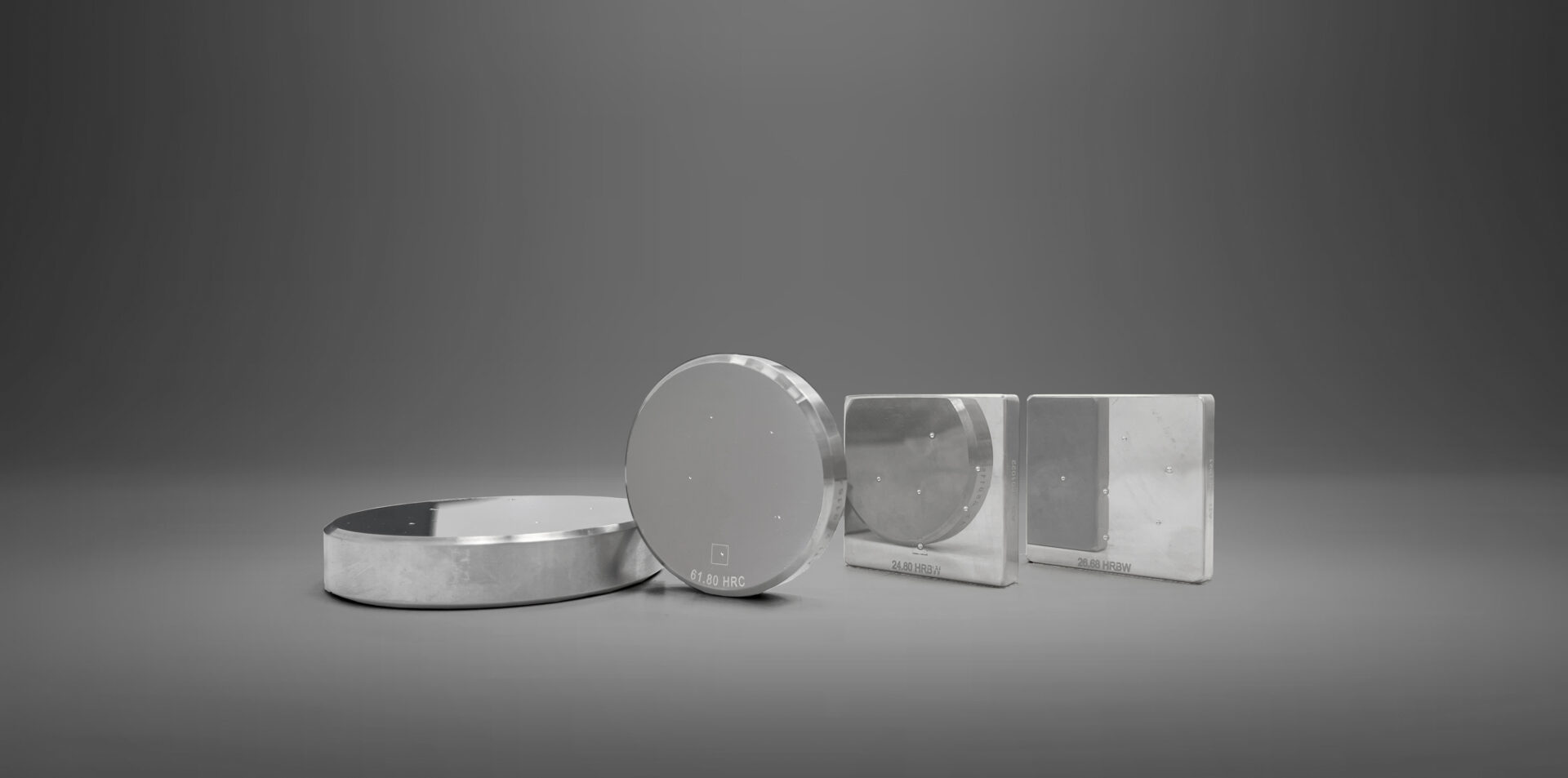
Keep your tester traceable with certified, scale matched reference blocks.
Why choose a certified hardness testing solution
Accurate hardness testing needs more than a reliable machine. It needs proper calibration, compliance with ISO/IEC 17025, traceable reference blocks and documented procedures aligned with the ASTM and ISO standards. Regular verification and calibration keep a tester delivering results that stay consistent over time and comparable across sites and laboratories. ATI supports this with an accredited calibration laboratory and certified reference blocks.
Frequently asked questions
Which hardness test method is the most common in production?
Rockwell is the most widely used method for production quality control because it is fast and gives a direct reading from the penetration depth, with no optical measurement of the impression.
Is hardness testing destructive?
Hardness testing is considered minimally destructive: it leaves a small indentation but does not break the part. For critical components, test locations are chosen to avoid functional areas.
Why do hardness values sometimes vary between methods?
Different methods use different indenters, loads and measurement principles, reading either depth or impression size. Results are not always directly interchangeable, especially across different materials and microstructures, which is why conversions are material specific.
Do I need calibration to trust hardness results?
Yes. Reliable results require verification with certified reference blocks and calibration traceable to recognized standards under ISO/IEC 17025. This is essential for audits, supplier approval and long term consistency.
Author and technical responsibility
Technical content reviewed by the ATI (Affri Testing Instruments) Metrology Engineering Team, with expertise in hardness testing methods, international standards and ISO/IEC 17025 accredited calibration.
ATI operates an ISO/IEC 17025 accredited calibration laboratory for hardness (ANAB accreditation AC 3026.01), whose results are recognized internationally under the ILAC Mutual Recognition Arrangement (ILAC-MRA). This accreditation underpins the traceability of our hardness testers, certified reference blocks and calibration services. See the accredited calibration scope for details.